
CAGR Calculator
Results
| Initial Value (₹) | Final Value (₹) | Years | CAGR (%) |
|---|
What Is CAGR?
CAGR stands for Compound Annual Growth Rate. Think of it as the "smoothing" tool for your investments. We all know that markets are volatile; one year your stock might go up 20%, and the next year it might drop 5%. CAGR ignores these bumpy ups and downs.
Instead, it gives you a single, representational figure that tells you: "If my investment had grown at a steady, constant rate every single year, what would that rate be?"
It is the most accurate way to measure the performance of an investment over a specific period relative to its time horizon.
Why CAGR Matters in Investing and Finance
In the world of finance, context is king. A 100% return sounds fantastic, but if it took 25 years to achieve, it’s actually a poor return (less than 3% annually).
CAGR matters because:
- It Standardizes Performance: It allows you to compare different asset classes (like Gold vs. Stocks) on an equal footing.
- It Filters Noise: It looks past the short-term market volatility and focuses on the final result relative to time.
- It Helps in Benchmarking: You can easily compare your portfolio's performance against standard benchmarks like the Nifty 50 or Sensex.
How a CAGR Calculator Works
A CAGR Calculator is an online tool designed to automate the complex math behind compound interest. It takes the manual effort out of the equation.
To work its magic, the calculator needs three specific inputs from you:
- Beginning Value: How much money you started with.
- Ending Value: What your investment is worth today (or at the end of the period).
- Duration: The time period (usually in years).
Once these are entered, the CAGR Calculator processes the data to give you a percentage that represents your mean annual growth rate.
Formula for CAGR (With Simple Examples)
While a CAGR Calculator is the easiest way to find the answer, it is good to understand the math behind it. The formula relies on the power of compounding.
The mathematical formula is:
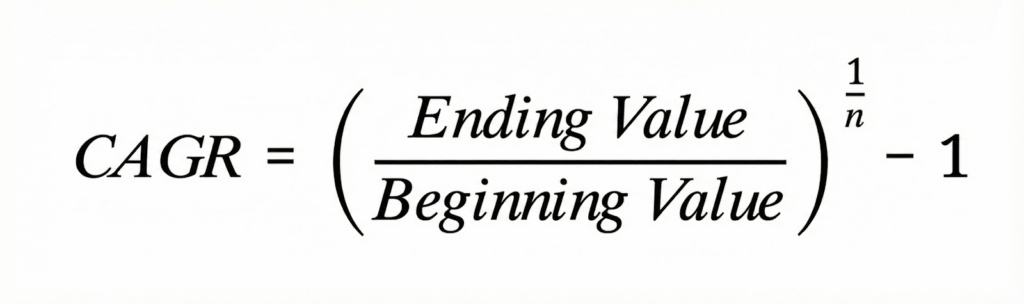
Where:
- Ending Value = The value of the investment at the end of the period.
- Beginning Value = The initial principal invested.
- n = Number of years.
A Simple Example of CAGR:
Imagine you invested ₹10,000 in a mutual fund. After 3 years, the value represents ₹15,000.
Using the formula:
- Divide 15,000 by 10,000 = 1.5
- Raise 1.5 to the power of (1/3) or 0.33 = 1.1447
- Subtract 1 = 0.1447
- Multiply by 100 to get percentage = 14.47%
So, your CAGR is 14.47%. Doing this manually can be tricky, which is why most investors prefer using a CAGR Calculator.
Benefits of Using a CAGR Calculator
Why should you switch to an online tool? Here are the top benefits:
- Accuracy: It eliminates human error. Dealing with exponents and roots manually often leads to calculation mistakes.
- Speed: You get instant results without needing a scientific calculator or spreadsheet.
- Comparison Shopping: You can quickly toggle between different scenarios (e.g., "What if I held this stock for 5 years instead of 3?") to see how time affects your growth.
- Planning: It helps you reverse-engineer your goals. If you know you need a specific return, the calculator helps you see if your current assets are performing up to the mark.
How can a CAGR calculator help you
A CAGR Calculator isn't just for looking at the past; it is a vital tool for planning your future.
- Evaluate Mutual Funds: When a fund manager claims they have doubled investor money, use the calculator to see the annual rate. It might not be as impressive as the marketing sounds.
- Goal Mapping: If you are saving for a child’s education, you can calculate the growth rate of your current savings to see if you will meet the target amount in time.
- Real Estate Analysis: Real estate is often held for decades. This calculator helps determine if that property appreciation actually beat inflation and standard bank rates.
CAGR vs Absolute Returns – Key Differences
Many investors confuse absolute return with CAGR. Here is the difference:
| Feature | Absolute Return | CAGR |
| Definition | The simple percentage growth from point A to Point B. | The average annual growth rate over a specific period. |
| Time Factor | Ignore time completely. | Heavily dependent on the duration (time). |
| Best Used For | Short-time investments (< 1 year). | Long-term investments (> 1year). |
| Example | “My stock is up 20%.” | “My stock grew at 12% annually for 5 years.” |
If you invest for less than a year, absolute return is fine. But for anything longer, a CAGR Calculator provides the true picture.
Real-Life Examples of CAGR Calculations
Let’s look at two distinct scenarios to see how CAGR applies in real life.
Scenario A: The Stock Market Volatility
You buy shares worth ₹1 Lakh.
- Year 1: Value goes to ₹1.5 Lakh.
- Year 2: Value drops to ₹1.2 Lakh.
- Year 3: Value rises to ₹1.4 Lakh.
Absolute return is 40% (₹40k profit on ₹1L). However, using a CAGR Calculator over 3 years, the growth rate is actually 11.87%. This shows the impact of that bad second year.
Scenario B: The Fixed Deposit
You put ₹1 Lakh in an FD for 5 years, receiving ₹1.35 Lakh at maturity.
The absolute return is 35%. The CAGR is approximately 6.18%.
Common Mistakes to Avoid While Calculating CAGR
Even with a CAGR Calculator, input errors can lead to wrong conclusions:
- Ignoring Dividends: If you received dividends and didn't reinvest them, your calculated CAGR might look lower than your actual total return.
- Wrong Time Frame: Ensure the "n" (years) is accurate. Using 3 years when the investment was actually held for 3.5 years will skew the result.
- Assuming Constant Growth: Remember, CAGR is an average. Just because the CAGR is 12%, it doesn't mean the asset grew exactly 12% every single year.
Limitations of CAGR You Should Know
While powerful, CAGR has blind spots:
- Ignore Risk: Two funds can have the same CAGR, but one might have been a steady climber while the other was a roller-coaster. CAGR doesn't show you the volatility risk.
- Sensitive to Time: The start and end dates heavily influence the result. If you calculate CAGR right after a market crash, the result will look terrible, even if the investment was good for the previous 9 years.
- Not for SIPs: CAGR works best for lumpsum investments. For Systematic Investment Plans (SIPs), you should use XIRR (Extended Internal Rate of Return) instead.
How to Use AK Shah Finance Online CAGR Calculator
Using the AK Shah Finance tool is designed to be intuitive and fast. Follow these simple steps:
- Locate the Inputs: Open the CAGR Calculator on our page.
- Enter Initial Value: Type in your initial investment amount.
- Enter Final Value: Type in the current value or maturity value of the asset.
- Enter Duration: Input the number of years you have held (or plan to hold) the investment.
- Click Calculate: Hit the button, and the tool will instantly display your Compound Annual Growth Rate percentage.
Advantages of AK Shah Finance online CAGR calculator
Why choose our tool over others?
- User-Friendly Interface: Clean design with no clutter, making it easy to focus on your numbers.
- Mobile Optimized: Calculate returns on the go, directly from your smartphone.
- Instant Results: Our advanced algorithm provides the result in milliseconds.
- Free to Use: Access the CAGR Calculator as many times as you like without any hidden charges or sign-ups.
FAQs CAGR Calculator
What is considered a good CAGR?
This depends on the asset class. For equity mutual funds, a CAGR of 12-15% is generally considered good over the long term. For FDs, 6-7% is standard.
Can CAGR be negative?
Yes. If your final value is lower than your initial investment, the CAGR Calculator will show a negative percentage, indicating an annual loss.
Is CAGR the same as XIRR?
No. CAGR is for lumpsum investments (one-time buy). XIRR is used when there are multiple cash inflows or outflows, such as in a SIP.
What is the difference between Average Annual Return and CAGR?
This is a very common confusion. Average Annual Return is a simple arithmetic mean (e.g., +10%, -10%, +10% / 3). It often overestimates your actual profit. CAGR is a geometric mean that accounts for the compounding effect. The CAGR Calculator is always the superior choice for volatile investments because it reflects the actual reality of your portfolio's growth over time.
Does a CAGR Calculator account for inflation?
No, the standard CAGR formula gives you the "nominal" return. It tells you how much your money grew in numbers. To find your "real" return (what your money is actually worth in purchasing power), you need to subtract the inflation rate from the CAGR. For example, if your CAGR is 10% and inflation is 6%, your real growth is roughly 4%.
Can I use the CAGR Calculator for periods less than one year?
Technically, you can, but it is not recommended. CAGR stands for Compound Annual Growth Rate. If you use it for 6 months, the formula will "annualize" that return (pretending you will get that same return for a full year), which can give highly misleading and exaggerated results. For less than a year, stick to Absolute Return.
Does the calculator factor in taxes and brokerage fees?
The calculator is a mathematical tool; it does not automatically know your tax bracket or broker fees. To get a post-tax CAGR, you should enter your net maturity amount (the amount you receive after taxes and fees are deducted) as the "Ending Value" in the CAGR Calculator.
How is CAGR useful for business owners?
CAGR isn't just for stocks. Business owners use it to track revenue, sales, or user growth. For instance, if you want to know how fast your startup's revenue has grown over five years to pitch to investors, you would use a CAGR Calculator to present a smooth growth percentage.
Why does my Mutual Fund SIP return look different from the CAGR?
If you are investing via SIP (Systematic Investment Plan), you are buying units at different prices every month. CAGR assumes a one-time lump sum investment at the start. For SIPs, you must use XIRR (Extended Internal Rate of Return), not CAGR, to get an accurate picture.
If my CAGR is 15%, does that mean I got 15% every year?
No. This is a theoretical smoothing. In reality, your investment might have gone up 30% in year one, down 10% in year two, and up 25% in year three. The CAGR Calculator smooths these bumps to tell you that, on average, your money grew at a pace equivalent to 15% annually.